Conference Program
Explore the detailed agenda for the AI and Philosophy conference, including session times, speakers, and discussion topics.
PROGRAM
April 16, 2026
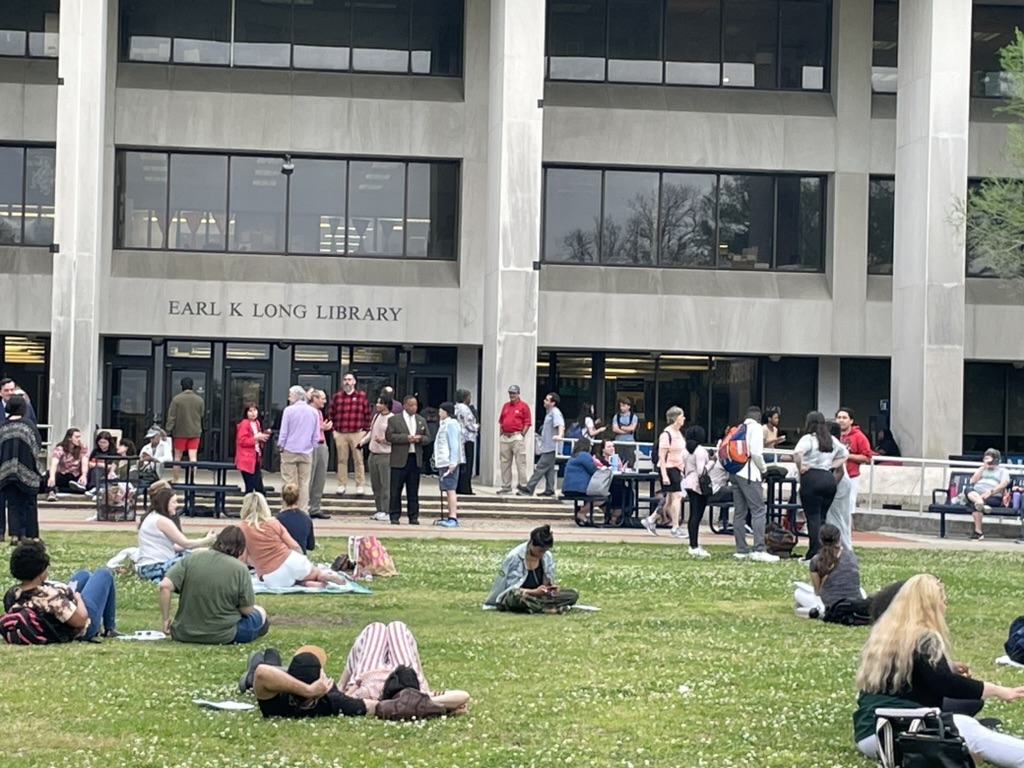
Earl K. Long Library at The University of New Orleans
8:00-8:30 – Registration
8:30-9:00 – Breakfast – Dougie Hitt Conference Room, Library 407
Welcome Remarks
9:00-10:30 – Dougie Hitt Conference Room, Library 407
AI Companions
- Ingrid Albrecht, Friends with Benefits? On Personal Relationships with Companion Chatbots
- Shannon Brick, Outsourcing Our Practical Reason: Artificial Intelligence and Interpersonal Relationships
- Lorenzo Manuali and Abdul Ansari, Can We Love AI Companions?
9:00-10:30 – Library 416
AI, Aristotle, Kant, and Hobbes
- Chong-Fuk Lau, Categories and Artificial Reasoning: From Aristotelian-Kantian Formalism to Hegelian Dynamic Holism
- Christopher Quintana, Technoamicitia: A Neo-Aristotelian Framework for User-Friendly Technologies
- Michael J. Ardoline, Submission and Technics: On the Two Political Imaginaries of AI in Western Philosophy
9:00-10:30 – Library 431
Truth, Thinking, Personhood
- Daniel Calzadillas Rodriguez, Ashes to Ashes, Code to Code: Phenomenology on Death and the Personhood of A.I.
- Trevor Griffith, Truth and The Proposition Machine
- Mark Walter, Thought’s Other: Artificial Intelligence and the Excess of Thinking
9:00-10:30 – Paper Workshop, Room TBA
- Chelsea Schwartz, Philosophers Reflecting on AI
- Finney Premkumar, A Principled Objection: Why Artificial Intelligence will never replicate Human Consciousness or Agency
- Julian Lee-Sursin and Arnold Fleishman, Curb Your (Brain-Model Alignment) Enthusiasm
10:40-12:10 – Dougie Hitt Conference Room, Library 407
AI vs Human
- Eric Sampson, Creating Utility Monsters: A Dilemma for Humanity
- Ella Zhang, AI as the New ‘Other’
- Rotem Herrmann, AI vs Human: Time-Consciousness and Agency in Musical Improvisation
10:40-12:10 – Library 416
AI and Research and Free Speech
- Benjamin Santos Genta, No AI Reproducibility? No Problem
- Anna Pederneschi, Peer Review by AI
- Mark Satta, Human Opinions and AI Viewpoints
10:40-12:10 – Library 431
AI and Work
- Conny Knieling & Anthony Nguyen, The Moral Exploitation of Data Workers
- Christopher Bousquet, Superhuman AI, Social Contribution, and Meaningful Work: Responding to the Threat of Technological Unemployment
- Siobhain Lash, Reconceptualizing Digital Privacy as Inalienable Property Rights
10:40-12:10 – Paper Workshop, Room TBA
- Mitchell Roberts, “Just like a Calculator”: When is it Permissible to Offload to LLMs?,
- Triston Hanna, AI Psychosis—A Feature, not a Bug.
- Chen-Wei Wu, Sensory Transduction and the Individuation of Cognitive Systems
12:10-12:50 – LUNCH
1:00-1:30 – INVITED SPEAKER
- Eamon Duede
1:30-3:00 – Dougie Hitt Conference Room, Library 407
AI and Moral Behavior
- Julianna Costanzo, Using AI to Promote Moral Behavior: The Trolley Problem and Meta Glasses
- Yan Zeng, Why Trustworthiness Cannot Be Engineered: A Structural Diagnosis of AI Trust
- Kelly Coble, Can Virtue Be Coded? Turing Machines and Moral Agency
1:30-3:00 – Library 416
AI and LLM: Parrots?
- Meredith McFadden, Large Language Models as Hybrid Epistemic Tools
- Mark Phelan, Speech Effects Without Intentions: Rethinking Meaning through Human-LLM Communication
- Mark Warren, Parrots in the Space of Reasons
1:30-3:00 – Library 431
AI, Authorship and Creativity
- Jason Swedene, AI, Authenticity, and Bad Faith: An Unexaggerated Report of the Author’s Death
- Jurgita Imbrasaite, What is an Author, ChatGPT?
- Jesse Hill, Can AIs be creative and is intention essential for creativity?
1:30-3:00 – Paper Workshop, Room TBA
- Jon Joey Telebrico, Epistemic Debt and Responsibility: Preserving Knowledge in an Age of LLMs
- Jonah Branding, Chomsky on cognitive trait individuation
- Simone Lee Quinn, Anonymous Algorithms, Real Power: What can Foucault tell us about our AI situation?
3:10-4:40 – Dougie Hitt Conference Room, Library 407
AI and using LLM
- Joshua Yen, LLM-Simulated Tutorials in Philosophy Education
- Dimitria Gatzia & Moriah K. Wood, Developing Metacognition Through LLM-Enhanced Writing Assignments
3:10-4:40 – Library 416
AI and Cognitive Science
- Zoe Drayson, AI and the role of abstraction in cognitive science
- Matthew Owen, (Meta)physical Factors for Covert Consciousness in Artificial Neural Networks and Organoid Intelligence: A Hylomorphic Perspective
- Fuyao Zhang, Why Consciousness Cannot Be Detected by Algorithmic Criteria
3:10-4:40 – Library 431
AI and Philosophy of Mind
- Louis Loock, How to Extract Your Cognition to an AI
- Daniel Bjorklund, Distinguishing between humans and AI on Two-tiered theories of intentionality
- Yunlong Cao, Understanding How It Works Defeats Mental Attribution
3:10-4:40 – Paper Workshop, Room TBA
- William Watkins, The Impact of Artificial Intelligence on Access Privacy
- Amani El-Sheikh, Daezhon Gilbarg, Jack Jacobs, Alex Lau, and Alexis Woods, The Interesting Gap in AI Companions for Older Adults or Amani El-Sheikh, Jack Jacobs, Alex Lau, and Alexis Woods, Griefbots and the Prudential Goods of Grief
- Gregory Ashby, Simulated Recognition and Identity Formation
5:00-6:00 – Dougie Hitt Conference Room, Library 407
KEYNOTE SPEAKER
- Susan Schneider
 AI and Philosophy